Pouch grade nonwoven fabric is no longer just a wrapping material. For modern oral pouch products, it directly affects sealing stability, pouch integrity, ingredient release, mouthfeel, lint control, production efficiency, and compliance readiness. Whether a brand is producing snus pouches, nicotine pouches, nootropic pouches, caffeine pouches, herbal pouches, or other functional oral pouch formats, the nonwoven substrate plays a decisive role in both manufacturing performance and end-user experience.
The demand behind this material category is also expanding rapidly. According to Grand View Research, the global nicotine pouches market was valued at USD 6.9 billion in 2025 and is projected to reach USD 42.4 billion by 2033, with a CAGR of 24.7% from 2026 to 2033. ResearchAndMarkets gives a similarly strong outlook, estimating the nicotine pouches market at USD 8.63 billion in 2026 and projecting it to reach USD 23.81 billion by 2030.
For pouch brands and contract manufacturers, this market growth creates a direct sourcing challenge: they need pouch grade nonwoven fabric that can support higher production volumes, stricter quality expectations, more diverse pouch formats, and increasing documentation requirements.
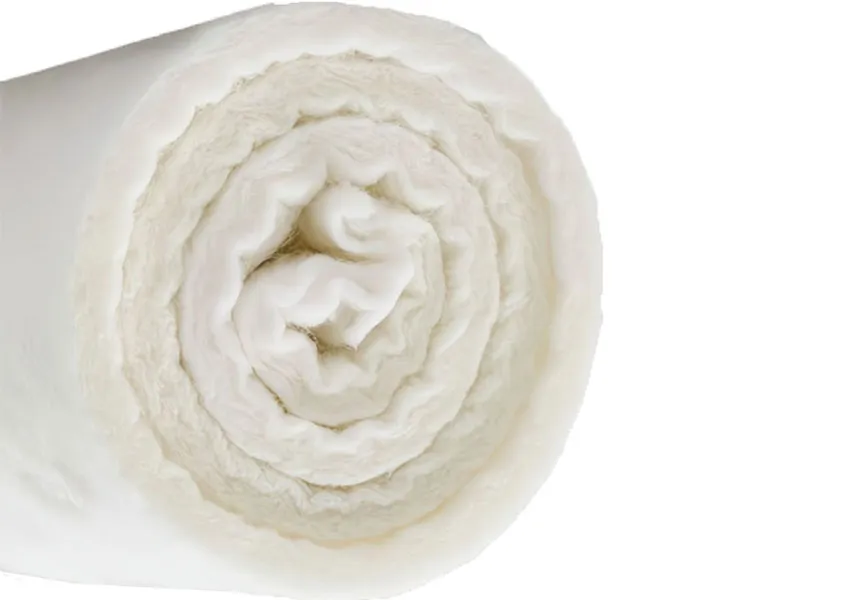
Pouch grade nonwoven fabric is a specialized nonwoven material designed for oral pouch packaging and filling systems. Unlike standard nonwoven materials used in wipes, hygiene products, filtration, or industrial applications, pouch grade fabric must balance softness, tensile strength, porosity, permeability, heat sealability, dimensional stability, low linting, and neutral sensory performance.
The Centers for Disease Control and Prevention describes nicotine pouches as “small microfiber pouches” that contain nicotine, flavorings, and other ingredients, and are typically placed between the lip and gum. This means the pouch material is not only a packaging substrate; it is also the user-contact surface that influences comfort, release, and product perception.
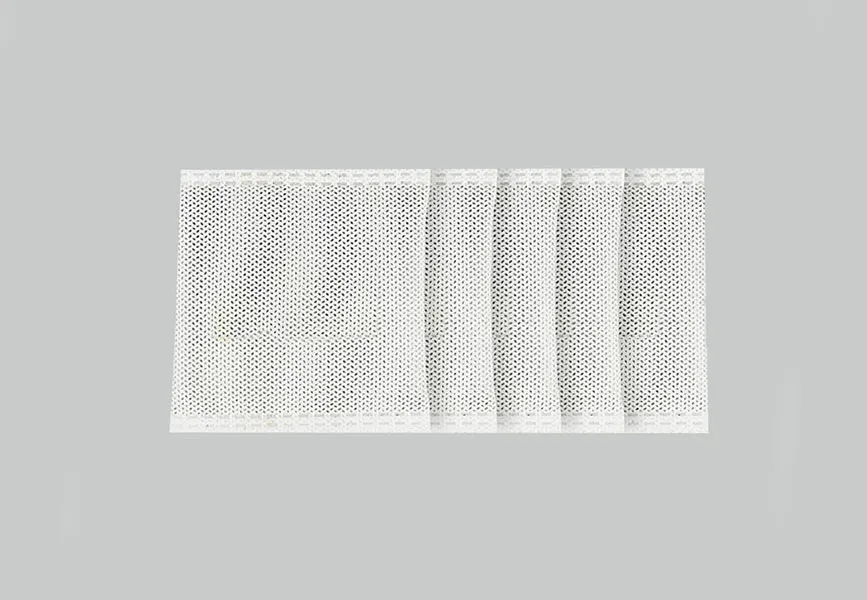
From a manufacturing perspective, pouch grade nonwoven fabric is usually supplied in rolls or slit rolls according to the required width of the pouch machine. Depending on the production line, the material may need to support continuous sealing, intermittent flat-jaw sealing, ultrasonic sealing, or other form-fill-seal processes. A material that works well on one machine may not perform equally well on another, especially when sealing temperature, pressure, dwell time, blade condition, and production speed vary.
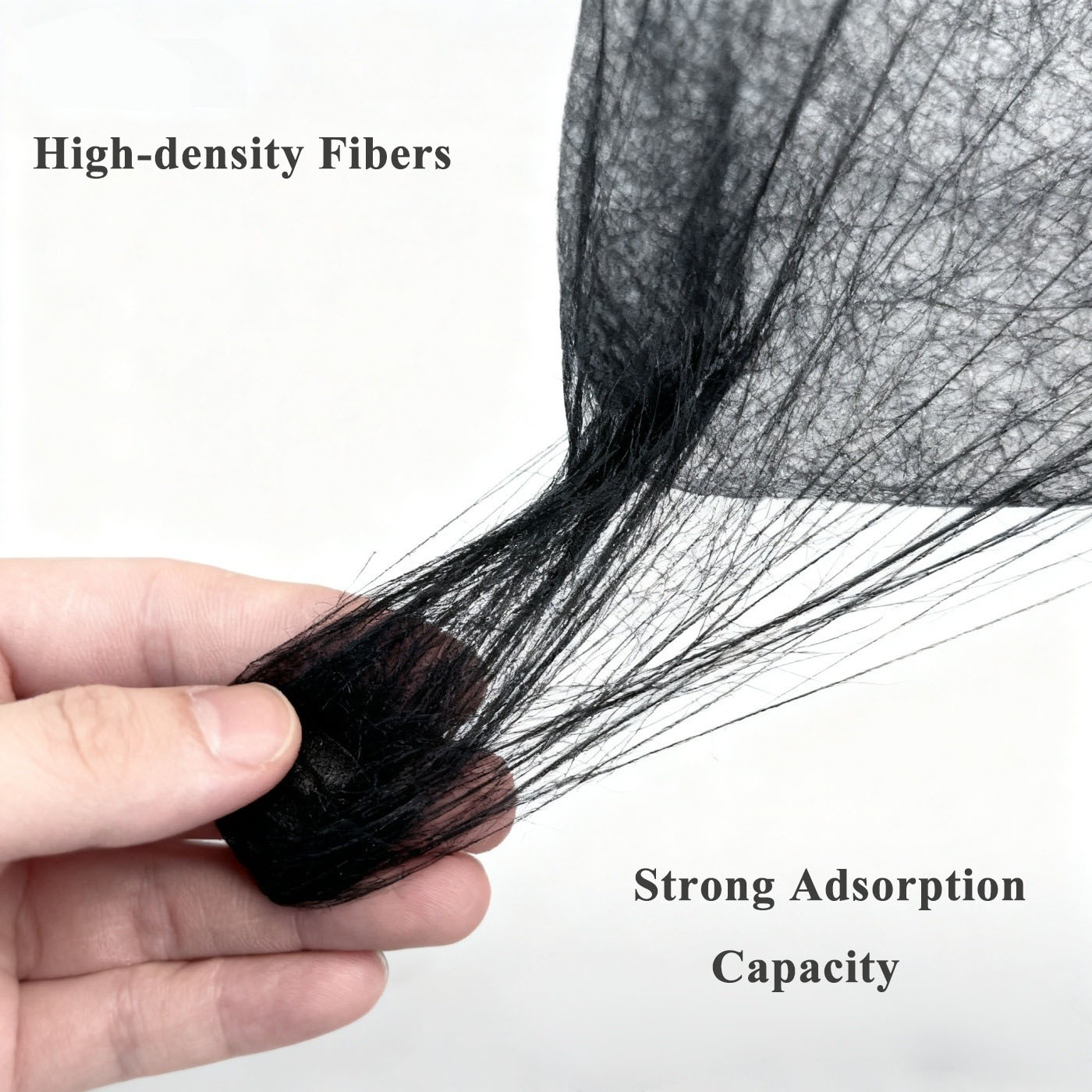
For end users, the pouch fabric is the part of the product they physically feel first. A rough, stiff, dusty, or poorly sealed material can immediately reduce product acceptance. For brand owners, this makes the nonwoven substrate a strategic component rather than a commodity material.
Leading pouch material suppliers also position nonwoven performance around sensory and release behavior. TENOWO states that pouch nonwoven solutions should focus on “durability, comfort, safety, absorption and release properties,” which reflects how closely fabric performance is linked to the final consumption experience.
A high-quality pouch grade nonwoven fabric should provide a soft and smooth tactile surface while maintaining enough mechanical strength to resist breakage during filling, sealing, packing, transportation, and use. It should help keep the filling inside the pouch while supporting controlled transfer of flavor, moisture, or other functional ingredients.
For premium oral pouch brands, mouthfeel and release consistency are especially important. If the material is too dense, release may be slow or uneven. If it is too open, powder leakage, poor containment, or an unpleasant surface feel may occur. If the fabric sheds fibers or creates lint during high-speed operation, it can affect product cleanliness and machine stability.
This is why pouch grade nonwoven selection should start with the target product experience. Is the brand developing a soft premium pouch? A high-strength pouch for fast filling lines? A cost-efficient material for low- to medium-speed machines? A product for regulated markets requiring stronger documentation and traceability? Each answer points to a different material specification.
The most important performance requirement for pouch grade nonwoven fabric is sealing stability. Weak sealing can cause pouch bursting, powder leakage, contamination risk, and machine downtime. Overly aggressive sealing, however, can create hard edges, stringing, blade sticking, or thermal damage to sensitive ingredients.
WPT Nonwovens summarizes several key purchasing concerns for nicotine pouch materials, including “strong, reliable heat seals,” “taste-neutral, soft, and low-lint performance,” consistent active ingredient transfer, clean operation on high-speed form-fill-seal lines, traceability, and TPMP alignment. These points are highly relevant for B2B buyers because they connect material properties directly with production efficiency and product consistency.
The second requirement is tensile strength. The material must withstand unwinding, tension control, folding, filling, sealing, cutting, and final packaging. A fabric with poor dimensional stability may stretch, wrinkle, or misalign during production, causing inconsistent pouch size and sealing defects.
The third requirement is permeability. Oral pouch fabric must allow moisture interaction and ingredient transfer while maintaining product containment. Nonwovenn’s PouchTech page also highlights pouch applications across nicotine pouches, health and wellness pouches, and snus or tobacco pouches, showing that modern pouch nonwoven is increasingly tied to different release profiles and product positioning.
The fourth requirement is low linting. In high-speed pouch manufacturing, fiber shedding can create visible defects, contaminate the machine area, and affect product cleanliness. Low-lint performance is especially important for premium markets, clean production environments, and brands that need consistent product appearance.
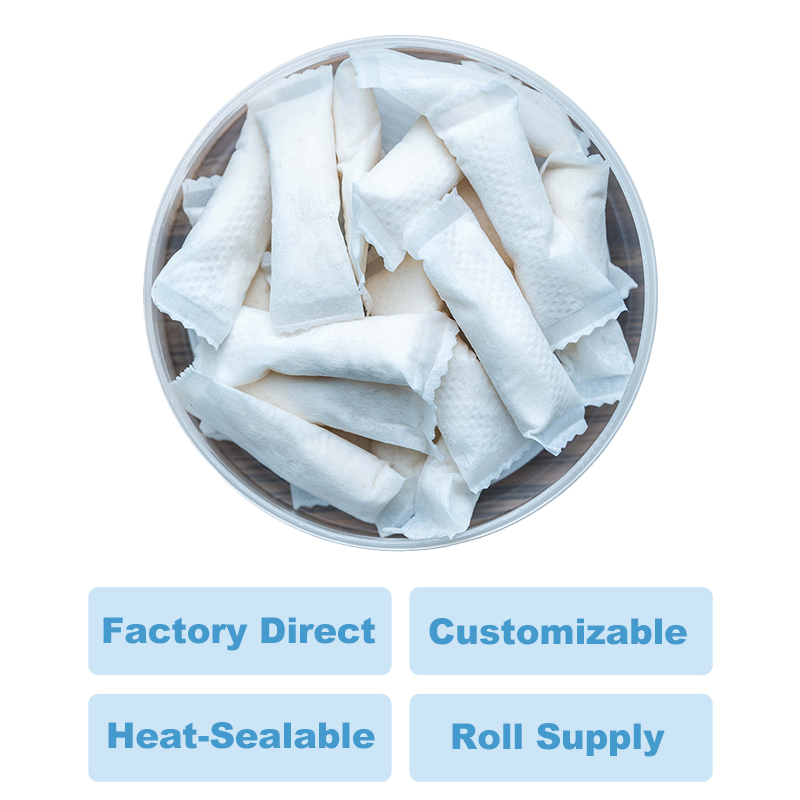
One of the most common mistakes in pouch material sourcing is treating all pouch grade nonwoven fabrics as interchangeable. In reality, machine compatibility matters.
For low- to medium-speed pouch lines, a chemically bonded nonwoven with strong structural stability may be suitable, especially when sealing pressure and temperature are relatively stable. For intermittent flat-jaw sealing systems, the material must tolerate repeated compression, impact, and localized heat without stringing or blade sticking. For high-speed pouch production, the material must deliver excellent web uniformity, ultra-low fiber shedding, clean sealing behavior, and consistent roll-to-roll performance.
Huiming’s pouch nonwoven portfolio can be positioned around this logic. HM-A is suitable for stable sealing on low- to medium-speed pouch machines. HM-01 is designed for intermittent flat-jaw sealing systems, helping reduce burst risk under fluctuating sealing conditions. HM-XY is positioned for high-speed nicotine pouch production lines, with a focus on sealing stability, low fiber shedding, and batch-to-batch consistency.
Product type also influences material selection. Snus and nicotine pouches may require strong sealing and stable release. Nootropic, caffeine, and wellness pouches may place additional emphasis on ingredient protection and sensory neutrality. Herbal or supplement pouches may require specific pore structure and liquid interaction behavior.
For B2B customers, the best material is not always the highest-specification material. The best material is the one that matches the customer’s product formula, pouch size, machine type, target market, compliance requirements, and cost target.
For pouch brands selling into regulated markets, material documentation is becoming increasingly important. Buyers may request food-contact documentation, migration testing support, Certificates of Analysis, raw material traceability, quality system certification, and product data sheets.
In the United States, FDA’s proposed Tobacco Product Manufacturing Practice framework shows that tobacco product manufacturers may need stronger controls around qualified suppliers, acceptance activities, process validation, laboratory controls, batch records, sampling plans, nonconforming product handling, and packaging or labeling controls. The FDA proposal specifically refers to requirements covering the “manufacture, design, packing and storage” of finished and bulk tobacco products.
For European food-contact contexts, the European Commission notes that the overall migration of substances from plastic food contact materials may not exceed 60 mg/kg food or 10 mg/dm² of contact material. While exact requirements depend on material composition, product classification, and market destination, this shows why migration, safety documentation, and material traceability should be considered early in pouch product development.
Regulatory attention is also increasing as pouch adoption grows. A UCL-led study found that nicotine pouch use in Great Britain increased from 0.1% to 1% of adults between 2020 and 2025, equivalent to about 522,000 people. The same study reported that 72% of users between 2022 and 2025 were men and 47% were under 25.
For B2B buyers, this does not mean pouch material suppliers should make health claims. Instead, it means suppliers should help customers reduce sourcing risk through stable specifications, controlled production, batch records, clean manufacturing practices, and available testing or certification support.
Huiming can position itself as a pouch grade nonwoven fabric manufacturer that supports ISO, FDA, CE, RoHS, and SGS-related documentation according to customer project requirements. This should be presented not as a generic certificate list, but as part of a sourcing risk-reduction system: stable specifications, controlled production, documented batches, available reports, and responsive technical support.
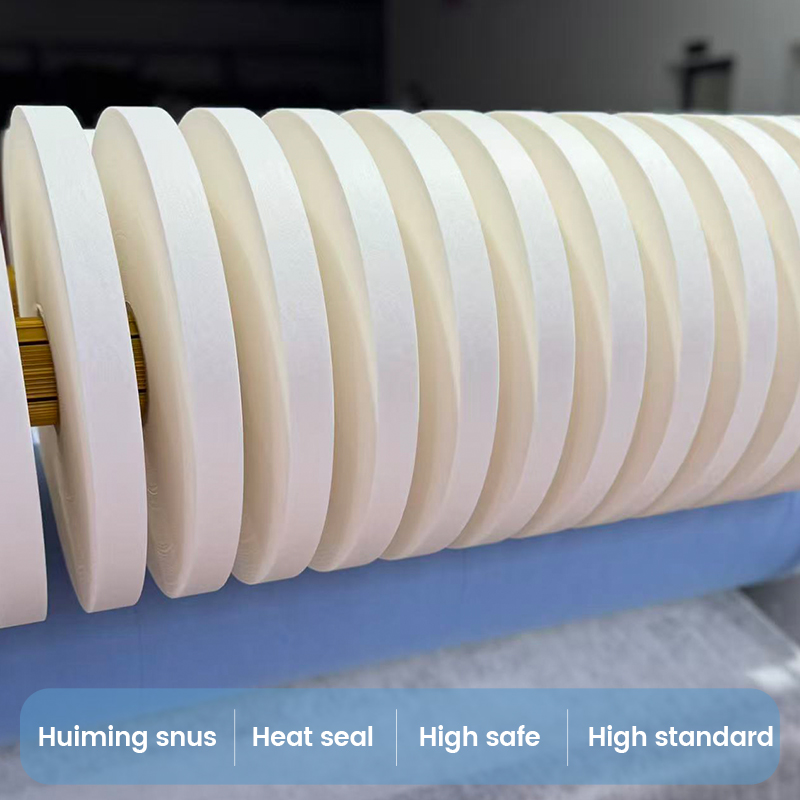
Every pouch brand has different material requirements. Some buyers need a softer handfeel for premium oral pouches. Others need stronger sealing for high-speed production. Some need a specific roll width to match their machine. Others need custom color, fiber composition, or packaging format for private-label projects.
Huiming can provide customization across four major areas.
Material and specifications: basis weight, width, color, fiber composition, surface texture, porosity, and strength level can be adjusted according to product positioning and machine requirements.
Product form: materials can be supplied as rolls, sheets, pre-cut pieces, folded products, or die-cut shapes depending on the customer’s downstream process.
Function and treatment: hydrophilic or hydrophobic treatment, antibacterial treatment, flame-retardant treatment, embossing, and other functional modifications can be developed for specific use cases.
Branding and packaging: logo printing, private label packaging, OEM labeling, and custom packaging design can support distributors, brand owners, and contract manufacturers.
This customization capability is especially valuable for buyers moving from trial production to scaled manufacturing. During early product development, small changes in material weight, width, bonding structure, or permeability may significantly improve pouch forming, sealing consistency, and user experience.
For B2B buyers, choosing a pouch grade nonwoven fabric supplier is not only about product samples. Samples may perform well, but the real test is whether the supplier can maintain the same performance across repeated bulk orders.
Large global pouch material suppliers often use production scale as a trust signal. Huiming’s manufacturing foundation can be emphasized as a key trust factor. The company has 30+ years of industry experience, a 2,000㎡ factory area, 100+ production equipment units, 50+ staff members, and annual production capacity of 3,000,000+. For project supply, monthly capacity can reach 250,000+, with maximum order volume of ≥100,000, standard lead time of 15–35 days, sampling time of 7–10 days, and an on-time delivery rate of ≥99%.
The company’s production facilities include Class 10,000 and Class 100,000 cleanrooms, as well as die-cutting machines, fabric slitting machines, folding machines, meltblown nonwoven production lines, PUR laminating machines, and spandex fabric production lines. This equipment setup supports multiple production forms and helps meet different requirements for precision cutting, roll slitting, lamination, folding, and functional material processing.
For overseas buyers, this should be translated into practical sourcing benefits: faster sample development, stable bulk production, flexible OEM/ODM support, controlled lead time, and fewer supply interruptions.

Huiming is not only a nonwoven fabric supplier, but also a manufacturer with in-house production, customization, quality control, and export-oriented service capabilities. For pouch brands and contract manufacturers, this means the communication loop is shorter: technical requirements can be discussed directly with the factory, samples can be adjusted quickly, and bulk orders can be controlled more efficiently.
Huiming’s pouch grade nonwoven solutions can support different production stages. For startup pouch brands, the company can help evaluate material specifications, roll width, sealing behavior, and sample feasibility. For established manufacturers, Huiming can support large-volume supply, private-label packaging, and stable repeat production. For regulated market buyers, documentation and certification support can be prepared according to project requirements.
A strong pouch material supplier should help customers solve four problems: product performance, production efficiency, compliance readiness, and supply stability. Huiming’s value lies in combining material engineering with factory-level execution. Instead of offering one generic fabric, Huiming can provide material options for different pouch machine types, sealing systems, market levels, and production volumes.
What is pouch grade nonwoven fabric used for?
It is used as the outer pouch material for oral pouch products such as snus pouches, nicotine pouches, nootropic pouches, caffeine pouches, herbal pouches, and other functional pouch formats.
What makes a nonwoven fabric suitable for oral pouches?
Key properties include food-grade safety, heat sealability, softness, permeability, tensile strength, low linting, dimensional stability, and neutral sensory performance.
Can pouch grade nonwoven fabric be customized?
Yes. Huiming can customize weight, width, color, fiber composition, product form, functional treatment, packaging, OEM labeling, and private-label presentation.
How long does sampling usually take?
Huiming’s standard sampling time is 7–10 days, depending on material complexity, specification requirements, and customization needs.
How should buyers choose the right pouch nonwoven grade?
Buyers should evaluate pouch machine type, sealing method, speed range, pouch size, filling formula, target market, documentation requirements, and expected order volume before selecting a material grade.
Pouch grade nonwoven fabric is a performance-critical material for modern oral pouch manufacturing. It influences sealing stability, pouch strength, mouthfeel, ingredient release, cleanliness, compliance readiness, and production efficiency.
Market growth, stricter buyer expectations, and increasing regulatory scrutiny are making material selection more important than ever. For B2B buyers, the right supplier should offer more than a roll of fabric. The supplier should understand pouch machine compatibility, material customization, quality documentation, and large-volume supply requirements.
As a China pouch grade nonwoven fabric manufacturer with 30+ years of industry experience, Huiming provides customizable material solutions for oral pouch brands, contract manufacturers, distributors, and OEM/ODM projects. Whether you need sample testing, roll-width customization, high-speed pouch material, private-label packaging, or stable bulk supply, Huiming can support your project from material selection to mass production.