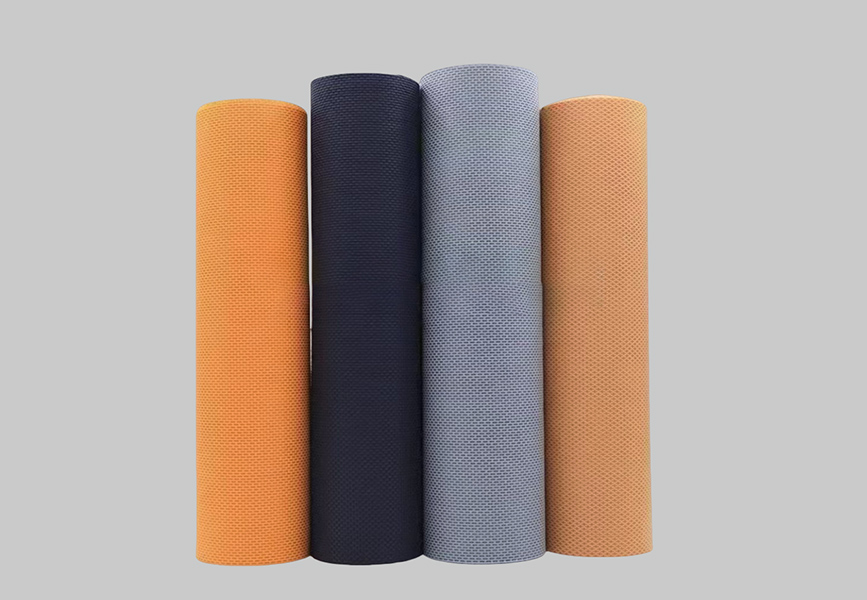
The melt blown nonwovens market is driven primarily by filtration, medical, and industrial applications that demand ultra-fine fiber structures, high filtration efficiency, and stable material performance. Unlike traditional market reports focused on speculative growth rates, real market dynamics are shaped by manufacturing capability, raw material stability, and application-specific requirements. From a manufacturer’s perspective, the melt blown fabric market is evolving toward customized grades, consistent quality control, and long-term wholesale supply partnerships rather than short-term volume expansion.
The melt blown nonwovens market occupies a critical position within the global nonwoven materials industry, serving as a foundational material for filtration, medical protection, hygiene products, and industrial applications. While many existing articles focus on market size projections and compound annual growth rates, such perspectives often overlook the manufacturing realities that actually define supply, quality, and long-term demand.
This article approaches the melt blown fabric market from a manufacturer’s standpoint, analyzing how production processes, material behavior, and application-driven performance requirements shape real-world market trends. Rather than replicating generic market research summaries, we aim to provide first-hand insights valuable to procurement professionals, engineers, and industry decision-makers seeking reliable meltblown nonwoven fabric solutions.
Meltblown nonwoven fabric is a synthetic material typically produced from polypropylene (PP) using the melt-blowing process. During production, molten polymer is extruded through precision-engineered dies and attenuated by high-velocity hot air, forming ultra-fine fibers with diameters generally ranging from 1 to 5 micrometers.
These fibers are randomly deposited onto a collector to form a self-bonded web with a highly porous structure. This microstructure gives meltblown nonwoven fabric several defining characteristics:
Exceptional filtration efficiency
High surface area
Low basis weight with strong performance
Adaptability for electrostatic treatment
In commercial contexts, the terms melt blown nonwovens market, melt blown fabric market, and meltblown nonwoven fabric are often used interchangeably. However, understanding their technical equivalence and practical differences is essential when evaluating materials for specific applications.
From a global perspective, the melt blown nonwovens market is shaped less by regional boundaries and more by application-specific demand. Unlike spunbond or needle-punched nonwovens, meltblown materials are rarely commodity products; they are performance-driven and highly sensitive to process control.
Key factors influencing the market include:
Growth in medical and respiratory protection
Expansion of industrial and environmental filtration
Increased emphasis on air quality and fluid purification
Demand for lightweight, high-efficiency material solutions
As a result, the melt blown fabric market continues to evolve toward specialized grades rather than standardized mass production.
Medical usage remains one of the most influential segments of the melt blown nonwovens market. Products such as surgical masks, respirators, and medical protective apparel rely on meltblown layers for their filtration and barrier properties.
In these applications, material performance is defined not only by filtration efficiency but also by:
Breathability
Fiber uniformity
Electrostatic charge stability
Compliance with regulatory standards
Certain medical devices also integrate meltblown materials as ventilator filter material, where consistent pore structure and pressure drop stability are critical for patient safety.
Application Share of the Melt Blown Nonwovens Market
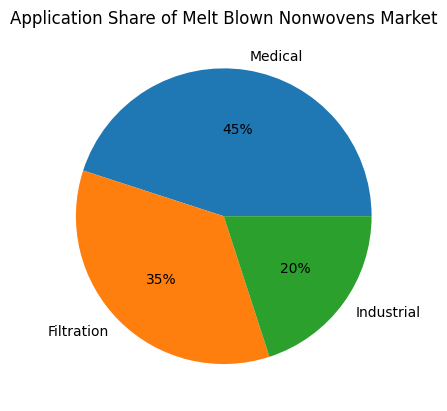
This chart illustrates the application-driven structure of the melt blown nonwovens market, where medical and filtration uses account for the majority of global demand. Unlike commodity nonwovens, meltblown materials are primarily consumed in performance-critical applications, which significantly influences material specifications and production priorities.
| Application | Key Performance Requirement | Material Requirement |
|---|---|---|
| Medical Masks | High filtration efficiency & breathability | Ultra-fine meltblown fibers with electrostatic treatment |
| Ventilation Filtration | Stable pressure drop & airflow | Uniform pore structure meltblown nonwoven fabric |
| Industrial Absorption | High absorption & durability | Composite meltblown layers with reinforced backing |
This mapping demonstrates how demand in the melt blown nonwovens market is fundamentally driven by application-specific performance requirements. Successful material selection depends on aligning end-use performance expectations with appropriate meltblown nonwoven fabric structures rather than relying on generic material classifications.
Industrial filtration represents another major pillar of the melt blown fabric market. Meltblown nonwoven fabric is widely used in:
Air filtration systems
Liquid filtration
Industrial dust control
In these scenarios, meltblown layers may be combined with other nonwovens or media, such as oil filter fabric, to achieve multi-stage filtration performance. Market demand in this segment prioritizes durability, chemical resistance, and long-term operational stability over short-term cost savings.
Common meltblown nonwoven fabric uses beyond healthcare and filtration include absorbent products, wipes, insulation layers, and specialty composites. These applications often influence the melt blown fabric wholesale segment, where buyers seek consistent supply, scalable production, and predictable quality rather than ultra-high filtration performance.
Public market reports often assume that installed capacity equals effective supply. In reality, the melt blown nonwovens market is constrained by multiple production factors:
Die precision and maintenance requirements
Polymer melt flow consistency
Control of fiber diameter distribution
Electrostatic treatment capability
Yield stability at industrial scale
These factors explain why high-quality meltblown nonwoven fabric for sale remains selectively available, even in regions with significant installed capacity. Manufacturers with advanced process control and in-house testing capabilities are better positioned to deliver consistent material performance.
Manufacturing Constraint: Installed Capacity vs Effective Supply
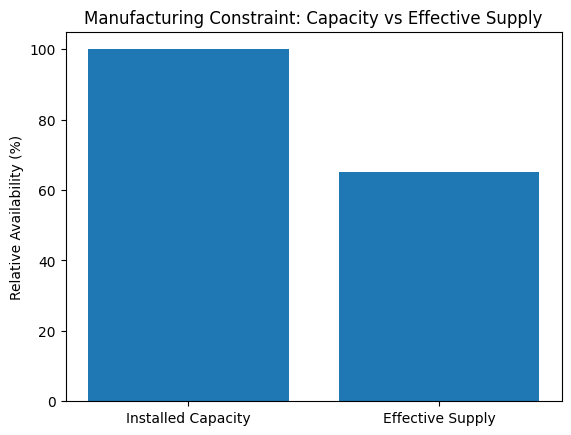
While many market reports equate installed capacity with available supply, actual effective output in the melt blown fabric market is significantly constrained by process control, material stability, and yield consistency. This gap explains why high-quality meltblown nonwoven fabric for sale remains selectively available despite apparent capacity expansion.
In the melt blown fabric market, quality differentiation is rarely visible at first glance. True performance differences emerge during downstream processing or end-use testing.
Critical quality indicators include:
Filtration efficiency retention over time
Pressure drop consistency
Fiber bonding uniformity
Absence of defects and contamination
Manufacturers supplying meltblown materials for sensitive applications often implement stricter quality protocols similar to those used in advanced nonwoven products such as controlled permeability formwork liner, where structural consistency directly impacts end-use performance.
For buyers sourcing melt blown fabric wholesale, price alone is an incomplete metric. Procurement decisions should consider:
Application compatibility
Batch-to-batch consistency
Long-term supply stability
Technical support and customization capability
In some composite structures, meltblown layers may be combined with materials like es hot air cotton or other nonwovens to achieve specific mechanical or thermal properties. Understanding these interactions is essential for successful product design and cost optimization.
From the perspective of meltblown nonwoven manufacturers, the market is transitioning from emergency-driven expansion to structurally stable growth. Buyers increasingly prefer:
Long-term supply agreements
Customized material specifications
Transparent production traceability
This shift favors manufacturers with vertically integrated operations and application-focused development capabilities rather than purely volume-oriented suppliers.
Rather than relying on speculative CAGR figures, the future of the melt blown fabric market is best understood through tangible trends:
Increased demand for application-specific grades
Greater emphasis on filtration efficiency at lower basis weights
Stronger regulatory oversight in medical and environmental sectors
Rising expectations for supply reliability and quality documentation
These trends indicate sustained demand for technically robust meltblown nonwoven fabric across global markets.
The melt blown nonwovens market is defined not merely by projected growth rates, but by manufacturing capability, application demands, and supply-chain reliability. Understanding the melt blown fabric market through a production-focused lens enables buyers, engineers, and industry stakeholders to make informed decisions rooted in technical reality rather than marketing assumptions.
As global demand continues to evolve, meltblown nonwoven fabric will remain a critical material supporting healthcare, filtration, and industrial innovation.
Demand is primarily driven by medical, filtration, and industrial applications requiring high filtration efficiency, fine fiber structures, and stable performance.
Yes, both terms refer to the same material category, though “meltblown nonwoven fabric” emphasizes technical structure, while “melt blown fabric market” is often used commercially.
Key factors include application compatibility, quality consistency, supply stability, and technical support rather than price alone.
Effective supply depends on process control, die precision, raw material stability, and yield consistency—not just installed production capacity.
The market is shifting toward customized, application-driven materials with long-term supply partnerships and stricter quality requirements.